The Gap That's Still Easy to Close
There's a gap in your company's defenses that's still easy to close today. Every day you spend waiting makes it a little wider.
Exposure Isn't Static
Most people think of security gaps as a one-time state — either you're vulnerable, or you're not. That misses what's actually happening.
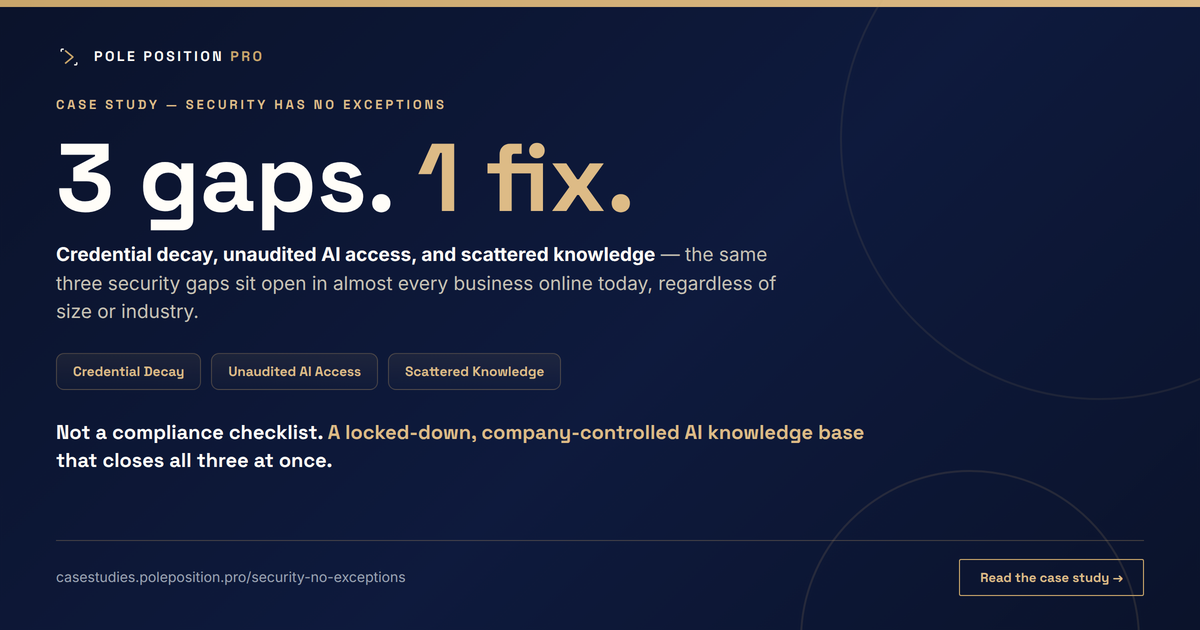
In one well-documented pattern, three specific gaps sit open in almost every business online today, no matter the size or industry: credential decay, unaudited AI access, and scattered knowledge. None of them exist because someone's doing something wrong. All three keep growing because the world around them keeps changing — more compute, more AI tools, more unmanaged integrations.
That's the part that matters. A static risk is something you assess once and move on. A growing exposure widens every month — and that's exactly what most people don't plan for.
What This Actually Looks Like
Take credential decay. Computing power keeps growing, and that keeps shrinking how long any password holds up. What took weeks to crack a few months ago takes hours now. That trend doesn't stop — every month on an aging setup narrows the margin a bit more.
Same with unaudited AI access. Maybe it's one chatbot or automation connected to a real system today, no review done. But every new tool added without bringing that surface under control makes the blast radius a little bigger.
And scattered knowledge isn't a one-time thing either — company data keeps spreading across more public AI tools and unmanaged integrations until nobody has a full picture of what lives where.
Today, these might still be theoretical risks. Six months from now, with another quarter of sprawl behind them, they can be real, exploitable entry points.
Why "Later" Feels Safer Than It Is
To be fair, waiting isn't the same as being careless. Maybe there are real priorities elsewhere right now. That's a legitimate call.
What's worth sitting with: right now, you're still the one deciding how big a surface you'll eventually have to close, and when. That control is exactly what fades the longer this sits.
Past a certain point, once the gap's wide enough, closing it stops being prevention. It becomes cleanup — rushed, pricier, and often happening after something's already gone wrong rather than before.
For today's automated, indiscriminate attacks, the only qualifying factor is being reachable online. "Too small to be a target" stopped being a safe bet a while ago.
What This Means Right Now
This isn't a case for dropping everything and overhauling your security overnight. It's a case for deciding on purpose — while the gaps are still a manageable size, not after they've already been used against you.
The case study behind this shows exactly how all three gaps close with a single, locked-down, company-controlled AI knowledge base, built on Zero Trust principles — full architecture, rollout plan, and a live dashboard showing exactly where things stand.
Curious how exposed your business actually is right now? Take the free AI audit.

